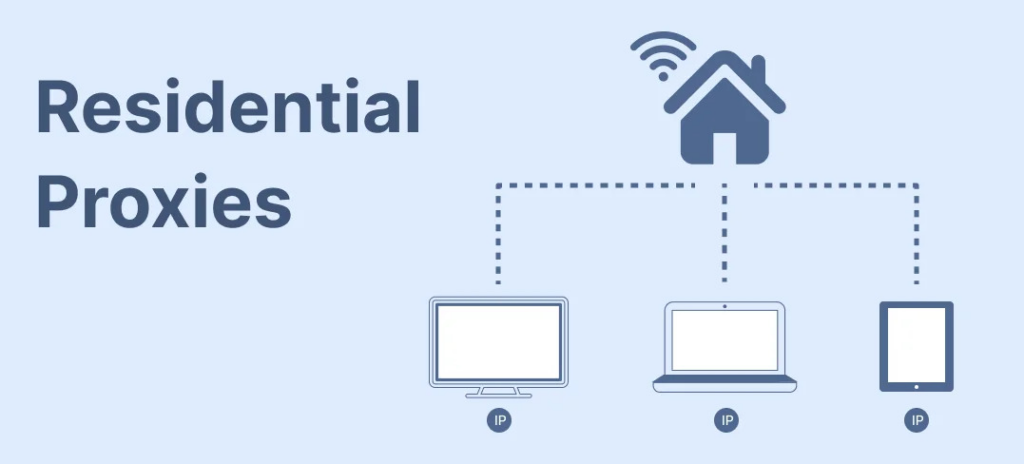
Residential proxies are essential to helping consumers across locations work efficiently, and even without being physically on site everywhere. As the internet shifts geographically, other sites, services, and platforms alter what users see and what they can find based on place. This makes it difficult for people and companies with a reliance on localised information, tools or content to access and use. In this case, residential proxies can address the issue by making users appear to be browsing while doing so from various real-world places.
How Residential Proxies Work Through Real IP Addresses
Key to this functionality is the use of IP addresses given to households by service providers. Whenever a user connects (via a residential proxy), their request is routed through one of these IPs so that it appears that they are the user of a normal home in a specific city or country. This enables the user to interact with the websites as if he/she is there, with no suspicion or conditions often faced by data centre connections.
Accessing Region-Specific Content
Residential proxies will provide access to content from a specific region, which is one of their primary duties in terms of cross-location work. A good portion of websites have content personalisation based on the user’s location. Variations like language differences, prices, product availability, and possibly completely different site layouts. With no proxy, users are restricted to the version they use in their country. With residential proxies, they can change platforms anywhere, where they can see the content as it seems for users, such that it provides a means of accessing and analysing data, especially when conducting research, comparing results, or determining whether something fits into a particular theme.
Managing Tasks Across Multiple Locations
A crucial advantage is consistency in multi-location task management. For instance, companies that work globally often have to check how their products show up in various countries. This will involve checking up on ads, validating local ads, and making certain websites run as they should in different parts of the country. Residential proxies enable these to be done from one place while also seeming present in various places simultaneously. It enhances productivity and diminishes the requirement for physical travel and distributed teams.
Data Collection Across Different Regions
Residential proxies are also helpful for data dissemination across different geographical areas. Site location can have an important impact on the response of websites when it comes to fetching information such as prices, search results, or product listings. One site IP is only going to show so much and can be biased. When users cycle through residential IPs from different geographical zones to get more representative and accurate data. This is vital to market research, competitive analysis and global tracking.
Testing and Development Across Locations
Another way that residential proxies can enable cross-location work is with testing and development. Developers and digital teams are often required to check how websites, applications or online services are performing when they’re in other locations. This includes inspecting localisation functionalities, payment systems, loading times, local laws, etc.
Simulating Global User Experience
Residential proxies help to simulate users from different countries without having to go to those places. This enables user experience consistency across the globe.
Account Management and Location Stability
They can also be helpful for users’ account management as well as regionally linked services. There are some platforms which restrict access based on location, and if the user starts to move between nations too fast, the sign-up process should be noted. Residential proxies also help keep account settings consistent by giving users the ability to connect from the same place each time, and thus reducing the probability of triggering security systems. Such is especially important for long-term account management or stable operations.
Comparing Global Markets
Moreover, residential proxies help to compare markets with another country. Companies frequently want to know how rivals are pricing their products, how promotions differ or how consumer behaviour varies from one region to the next. They can acquire useful insights from websites from multiple places, where it would have been hard for them to find those insights. This results in superior decision support and more rational strategy implementation when launching/crossing new areas to/from the market or expanding into other fields.
Bypassing Geographic Restrictions
Yet another benefit of working around geographic limitations. These services are only available in certain countries (due to licensing agreements, different regulations or business policies). Without a proxy, users who are outside of those regions can be totally blocked. Residential proxies enable access to the services by establishing an IP address accessible in an approved local area. It can also be useful in a legitimate manner, like for content verification, research, or handling regional processing.
Maintaining Natural Browsing Behaviour
Residential proxies also enable users to track a natural browsing trend when moving from one location to another. On many websites, rapid or unrealistic location changes can activate detection systems. As residential proxies employ real IP addresses of real sites in their proxy accounts, they are natural sounding and also less likely to be flagged. Users cannot suffer a delay in tracking down their place with captchas or blocks, since they can perform location-based operations more seamlessly.
Reliability in Cross-Location Workflows
Another major advantage is that cross-location workflows benefit from better reliability. Users working with more types of fake proxies will face too many blocked access or some non-standard access, which makes the work very hard for the user. A residential proxy alleviates these pain points by providing a secure and reliable provider that the website is more likely to choose. It allows for a frictionless experience when you work across borders.
Supporting Remote Work and Global Operations
Residential proxies enable remote work in a world of globalisation at long last. However, as so many people work today on a global scale, working across countries, regionally specific tools, dashboards or services often need to be accessed. Through the use of residential proxies, users can connect to the appropriate website or mobile application to get the job done when it needs to be done. This is conducive to increased productivity and adaptability in distributed teams.
Final Idea
The point is, your proxy may be in a location, and then the ‘residential proxy’ is able to work in a different location, but they still have access to the internet of the remote area. They enable users to see contextually relevant content, obtain trusted data, maintain consistent accounts, and bypass geographic limitations. Working in a way that mimics real user activity in multiple regions, they drive faster, more flexible and more reliable workflows in an increasingly digital world of locations.