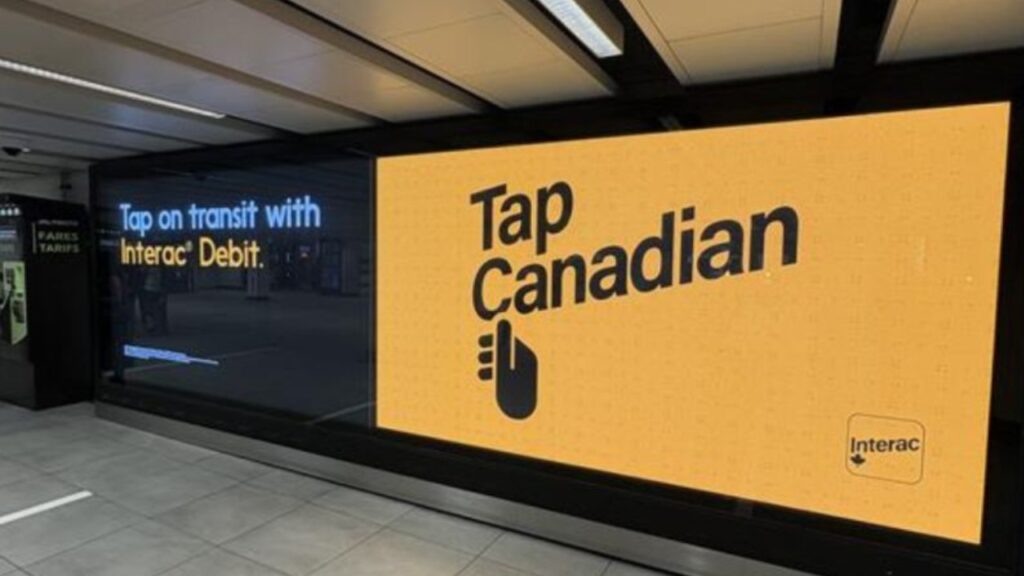
Long before instant payments were a global fintech buzzword, Canadians were already using Interac to send each other digital payments. Now some 20 million Interac transactions are made every single day, accounting for billions of dollars in transactions per year. Interac stickers are common sights on store fronts throughout the country. In many ways Interac has been one of the most successful national fintech projects anywhere in the world.
This article will look at how that happened, from 1984 to now. Covering who started Interac and why, and what made it so well positioned to capture the Canadian market almost entirely in the way it has today.
Interac Was Built Around Canada’s Banking System
Interac was first developed in 1984 as a collaboration between the big Canadian banks – RBC, CIBC, Scotiabank, TD, and Desjardins. It was conceived as a way of letting customers from any Canadian bank withdraw cash from any ATM across the country.
Unlike the fragmented US system, Canadian banks agreed from the outset of digital banking that they would work together on payment infrastructure. Crucially this success meant most Canadians were already aware of and trusted Interac before modern online banking and mobile payment systems took off.
It also meant the operation, which was then an association of companies, was well placed to step into launching new financial products and systems when the technological rush intensified in the late 90s.
How Interac e-Transfer Took Off in the 2010s
Interac e-Transfer launched in 2003. This meant it was already an established service when e-commerce really started to take off in 2007. Plus, because of its established scale and the backing of big banks it could offer the service at a low cost. For a long time Interac charged retail merchants just 1 cent per transaction. While higher now, it is still cheaper than most of its competitors.
For example, during this period Interac helped Canada become one of the earliest countries with widespread chip and pin card payment adoption.
With the rise of smartphone banking in 2010, and the introduction of phone-based card payments, the service became even more integral to the way many Canadians live their daily lives. The COVID-19 pandemic accelerated this trend ever further, as instant digital payments became even further normalized.
Thus, Interac Online quickly grew into one of the fastest growing divisions of the operation. Today, some 88% of Canadians have used Interac e-transfer in the past year.
Where major US services like PayPal, Venmo and CashApp were independent fintech operators that worked with big banks, Interac was the big banks. So it offered a stable, trusted alternative for Canadians not wanting to use American fintech systems.
Interestingly it was only in February 2018 that the company actually became a corporation, rather than an association. Today, it is still headquartered in Royal Bank Plaza, Toronto.
Online Gambling and Other Online Services Expanded Usage
Fast forward to 2026 and instant payments are a huge part of the Canadian economy. 88% of Canadians have used Interac instant payments. One big multi-billion CAD business that relies heavily on instant payments is the expanding gambling sector.
Gambling operators favour payment systems that are simple, fast and a known quantity to customers in a very competitive market. In Canada, that made Interac one of the main choices.
Today, finding casinos that accept Interac is a big priority for many Canadian gamblers. So much so that casino comparison sites have whole pages dedicated to the topic, alongside in-depth information about bonuses, game selection and other casino factors.
Operators offering gambling services to Canadians quickly adopted Interac payments because they offer near instant deposits and withdrawals via a trusted service and brand Canadian players are familiar with. It also works well on mobile platforms, which have become most gamblers’ preferred way to play.
Another big business that makes use of Interac payments is the gig economy. 42% of small business owners in Canada use Interac for payments, and 22% of people participate in gig work from side hustles to freelancing. Freelancers can even send invoices to clients directly through Interac.
Instant payments are important for freelance and gig workers, who may have multiple streams of income and jobs to juggle – so getting paid quickly cuts down on administration time.
Today Interac is Part of Everyday Life for Many Canadians
Because of the above reasons – integrated with big banks, first-mover advantage, simple, low cost and fast payments – Interac now processes some $300 billion CAD across a billion-plus transfers annually and over 90% of Canadians use at least one of its services.
Paying rent. Sending money to family or friends. Splitting bills at restaurants. Paying freelancers. Online shopping or entertainment services like casinos or sports betting.
All of these things are common everyday transactions that Canadians use Interac for, in a way that not many countries developed so centrally. Canada’s real-time e-transfers were already standard across the country before US competitors Cash App and Venmo were even founded.