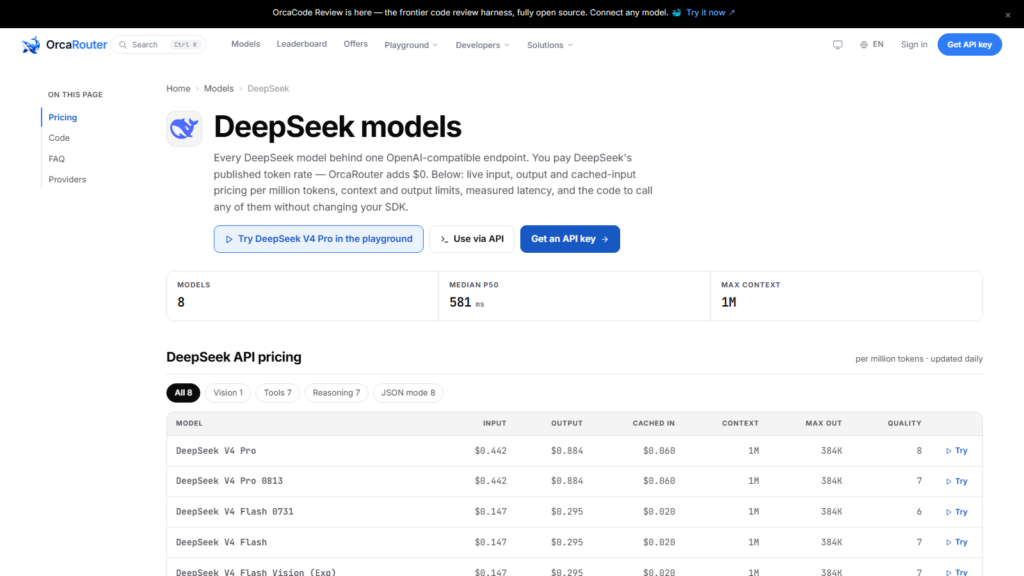
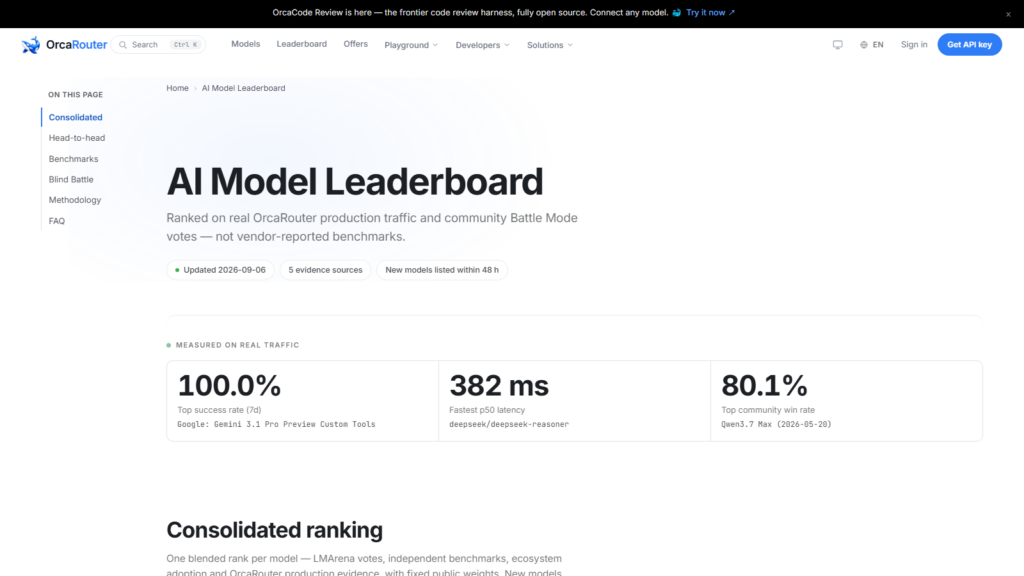
The short version, stated as a conclusion: make the chat model your default and treat the reasoning model as a deliberate escalation. The reasoning model you reach through the DeepSeek API earns its extra time and tokens on a short, specific list of jobs: hard debugging, multi-step math, and planning under constraints. On everything else it quietly wastes both. Before you commit either way, check both models’ current pricing and context limits on the DeepSeek provider page and see where each sits today on the AI leaderboard, because those standings move and a default chosen on last quarter’s figures is a default chosen badly.
This decision deserves more attention than it usually gets because it is made once and paid for thousands of times. Whatever default you set (usually one model name in an environment variable) gets applied to every request that doesn’t explicitly override it. Route everything through the reasoning model and you pay a thinking tax on messages that never needed a moment of deliberation, while your users wait for answers that were never in doubt. Avoid the reasoning model entirely and you ship fluently wrong answers on exactly the jobs where being wrong is expensive. The good news is that both handles sit behind the same endpoint and differ by one string, so the cost of getting this right is a routing rule, not a re-architecture. The hard part is knowing which requests deserve the wait, and that list is shorter than most teams assume.
What’s the actual difference between deepseek-chat and deepseek-reasoner?
Both handles hit the same API with the same key and the same request shape. deepseek-chat runs a single pass: prompt in, answer out, with latency steady enough to plan a UI around. deepseek-reasoner does something structurally different: before it writes the answer, it writes its thinking, a hidden chain of thought that works through the problem step by step. That thinking comes back in a separate field from the final answer, and it is billed as output tokens.
That last sentence is the one to underline. The reasoning model’s slowness is not overhead around the product; the thinking is the product. It is where the extra quality on hard problems comes from, and it is also what you are paying for when you send it a request that needed no thought at all.
The practical consequences follow from that one mechanic. Latency scales with how long the model deliberates, so it is unpredictable in a way the chat model’s is not: a trivial prompt can come back quickly, a genuinely hard one can take far longer, and you cannot cap the thinking without capping the quality. And because the thinking is generated text, a workload that routes everything through the reasoner multiplies its output-token bill by a factor you do not control directly; you control it only by choosing which requests go there in the first place.
|
|
deepseek-chat |
deepseek-reasoner |
|
How a request runs |
Single pass: prompt in, answer out |
Hidden chain of thought first, then the answer |
|
Latency profile |
Steady enough to plan a UI around |
Scales with how long the model deliberates |
|
Thinking tokens |
None |
Generated text, billed as output tokens |
|
Simple formatted requests |
Hews to the instruction as given |
Deliberation can drift past the constraint |
|
Home turf |
Conversation, summarization, extraction, classification, templated generation |
Debugging, multi-step math, planning, agentic decisions |
Which jobs justify the reasoning model’s wait?
The test I use: does this request contain a step where the model has to hold something in mind and reason about it, and would I notice and care if the answer came back fluently wrong? If both answers are yes, the reasoner earns its place. Concretely:
Debugging where the error message lies. The bug whose cause sits two files away from where the stack trace points, the state that gets mutated somewhere nobody is looking, the race that only appears under real load. This is deliberation work: forming hypotheses, ruling them out, holding the codebase’s shape in mind.
Math and quantitative logic beyond arithmetic. Multi-step derivations, chained unit conversions, constraint problems where an early sign error poisons everything downstream. The chat model is fine at arithmetic; the reasoner is for problems where the path matters as much as the result.
Planning under constraints. Migrations, refactors, scheduling, sequencing: anything where operations have an order and a bad plan only surfaces late. A wrong plan from a fast model is expensive precisely because it arrives early and confident.
Agentic decision steps. When the model must choose which tool to call, in what order, and a wrong choice cascades through everything after it, the extra thinking is cheap insurance.
Data transformation where the rules interact. Nested conditionals, ambiguous schemas, mappings where two requirements pull in opposite directions and the model has to reconcile them rather than pattern-match.
Notice what the list has in common: every job on it is one where the first draft being wrong costs more than the wait does. That is the whole trade in a single sentence. The gap between the two models also widens with difficulty: deliberation earns the most on genuinely hard problems, which is exactly why the reasoner should be reserved for the top of your difficulty distribution rather than spread across all of it.
What goes wrong when you route everything through the reasoning model?
The failure mode teams discover in production is not that the reasoner is bad at easy tasks. It is that easy tasks don’t benefit, and the costs arrive from three directions at once.
Latency first. On any interactive surface (a chat window, inline suggestions, anything a human is staring at a spinner for), every reply waits for deliberation the user never asked for. The app feels broken even when the answers are fine, and no amount of frontend polish hides a wait that scales with the model’s mood.
Then instruction drift. On simple requests (a summary to a set length, a reply in a fixed format, a rewrite in a given tone), the extra deliberation can talk the model past your instructions rather than toward them. The pattern to watch for: answers that are correct in substance but quietly ignore a formatting constraint, because the thinking spent its effort somewhere the prompt never needed. The chat model, answering in a single pass, hews to the instruction as given.
Then cost. Thinking tokens are output tokens, so a queue of trivial requests each carries hidden thinking nobody approved. That shows up as a budget line with no corresponding quality gain: the worst kind of line item, because nothing visibly broke.
Which is simply to say that the chat model’s home turf is large: conversation, summarization, extraction, classification, translation, templated generation, any request whose shape is known in advance. None of these get better with deliberation added. Most get worse.
How do you pick per request instead of per project?
Set the chat model as the default and escalate on triggers, not on vibes. In practice that is a routing rule with five steps:
• Set `deepseek-chat` as the default. Every request starts on the fast path; nothing reaches the reasoner without a reason.
• Escalate on triggers. The triggers that have held up in practice: the user asks why, or asks for a proof or an optimization; code arrives with a failing test; the request carries multiple constraints that must be satisfied together; or a previous chat-model answer was wrong and the fix isn’t obvious.
• Split by surface. Interactive features belong to the chat model almost without exception. Background work (nightly analysis, batch evaluation, report generation) can afford the reasoner wherever output quality justifies it, because nobody is watching the spinner.
• Verify the economics on the day you decide, not the day you read a blog post (this one included). Relative prices and speeds move often enough that the right routing rule last quarter can be the wrong one now; the provider page and the leaderboard exist precisely so you don’t have to trust anyone’s prose.
• Run both models on a sample of your real prompts and look at where the answers diverge. This is the step teams skip, and it is the one that actually decides the question: a support desk and a code-review pipeline will land on different answers to the same headline question, and only your own traffic knows which one you are running.
The takeaway
The verdict: the reasoning model is not a better version of the chat model; it is a different tool that happens to share an endpoint. Default to deepseek-chat, route the short list of genuinely hard jobs to deepseek-reasoner, and let triggers rather than defaults make that call per request. If a request’s first draft being wrong is expensive, the wait is worth paying. If it isn’t, the wait is the most expensive thing in your stack. The teams that get this right don’t pick a model; they pick a rule, and the rule is almost always the same: fast by default, thoughtful on purpose.
Sourcing note: written 2026-09-07. This article quotes no benchmark scores, prices or latency figures of its own, because model pricing, speed and rankings change often enough that a number in prose is stale on arrival; current figures live on the two linked OrcaRouter pages. The model behavior described here reflects the documented design of the DeepSeek API as of the date above.