For years, I accepted international roaming charges as an inevitable tax on leaving my home country. The logic was simple: my carrier offered a daily pass, it worked everywhere, and I would get a bill at the end of the month. The shock came not from the service quality but from the final number. On one trip to Europe, my roaming bill exceeded the cost of my flight. That was the moment I started exploring alternatives. The first alternative that actually stuck was a digital service that requires no physical card, no store visit, and no surprise fees: Iroamly esim. What I discovered over the following months was not just a cheaper way to get data, but a fundamentally different approach to planning connectivity—one that treats data as a prepaid utility rather than a postpaid liability.
The Real Cost of Staying Connected Abroad
The traditional model of international roaming is designed for convenience, not transparency. Home carriers charge per megabyte or offer flat daily rates that sound reasonable until you realize they apply to every single day of your trip, regardless of how much data you actually use. Local SIM cards are cheaper but require time, paperwork, and often a compromise on plan flexibility. The eSIM model introduces a third path: prepaid data packages that are purchased before departure, installed digitally, and activated upon arrival. The pricing is fixed. There are no daily surcharges, no per-minute fees, and no line items that require a magnifying glass to decipher.
From a practical user perspective, the financial benefit is clear, but the operational benefit is equally important. You know exactly how much you are paying before you leave. There is no bill shock waiting in your inbox two weeks after you return. The service operates on a prepaid basis, which means your purchase covers the entire plan, and there is no automatic renewal unless you choose to top up manually. The payment methods are standard: credit cards, PayPal, Google Pay, Apple Pay, and Alipay are all supported. The processing is handled through secure gateways like Stripe and PayPal, which adds a layer of trust.
Breaking Down What You Actually Pay For
The service offers three main plan categories, each structured to match different travel habits. Understanding these categories is the first step to choosing the right one.
Daily Plans: Predictable Consumption
These plans give you a fixed amount of high-speed data per day, which resets every 24 hours. They are ideal for travelers who use data moderately—checking maps, messaging, and occasional social media. The daily cap ensures you do not overshoot your budget, and the reset mechanism means you get a fresh allocation each morning.
Total Plans: One-Time Allotment
These plans provide a lump sum of data that lasts for the entire validity period—typically 7, 15, or 30 days. Once you use up the data, the connection stops until you purchase a top-up. This is suitable for travelers who know their total data consumption for the trip and prefer not to think about daily limits.
Unlimited Plans: Worry-Free Usage
These plans offer unlimited data for the duration of the package. They are best for heavy users who stream, attend video meetings, or tether multiple devices. It is worth noting that unlimited does not always mean unthrottled—some local partners apply fair use policies that may reduce speeds after a certain threshold, though this varies by country and network.
All paid plans support hotspot tethering, which means you can share your connection with a laptop, tablet, or travel companion. This is a significant advantage over some local SIMs that either restrict tethering or charge extra for it.
Testing the Service Across Three Distinct Destinations
To evaluate whether the pricing transparency translates into actual performance, I tested the service in three different regions: a week in London, a long weekend in Istanbul, and a two-week road trip across California and Nevada.
London: Urban Density and Network Congestion
Testing Task / Difficulty: Navigating a dense city with variable signal strength in underground tubes and busy commercial areas.
Actual Performance: The eSIM connected to a local partner network immediately upon landing at Heathrow. Throughout the week, coverage was consistent in central London and even in the Tube tunnels, where some networks lose signal. Speeds were sufficient for streaming podcasts and using ride-hailing apps. The daily plan I chose provided 1GB per day, which I never fully exhausted.
Strengths and Limitations: The coverage was reliable, but I noticed that during peak hours in crowded areas like Oxford Street, speeds dropped noticeably—a symptom of local network congestion rather than the eSIM itself. The result may vary depending on which partner carrier is assigned to your specific plan.
Who This Works For: Urban travelers who prioritize reliability and don’t want to hunt for Wi-Fi hotspots.
Istanbul: A Gateway Between Continents
Testing Task / Difficulty: Testing the turkey esim option specifically for navigating the historic peninsula, using translation apps, and uploading photos in real time.
Actual Performance: I opted for an unlimited plan for the weekend. Activation was smooth, and the connection held steady across the Bosphorus, from the European side to the Asian side. Translation apps worked without lag, and photo uploads to social media completed quickly. The service did not impose any visible throttling during my usage.
Strengths and Limitations: The unlimited plan removed any anxiety about running out of data. However, the plan duration was tied to a 7-day validity, which was more than I needed for a weekend—a minor inefficiency for very short trips.
Who This Works For: Vacationers who want to document their trip without worrying about data caps.
California and Nevada: Long-Distance Road Trip
Testing Task / Difficulty: Maintaining connectivity across highways, national parks, and small towns with intermittent coverage.
Actual Performance: I purchased a total data plan for 15 days. Coverage was strong in cities and along major interstates, but in remote areas like Death Valley and stretches of Route 66, the signal dropped to 3G or disappeared entirely. This was expected—no service can guarantee coverage in the middle of a desert. For navigation, I downloaded offline maps as a backup.
Strengths and Limitations: The service was reliable where coverage existed, but it did not perform magic. The limitation here is structural: the service relies on local partner networks, and if those networks do not cover a remote area, the eSIM will not connect.
Who This Works For: Road trippers who stick to major routes and urban corridors, not backcountry explorers.
The Step-by-Step Process: What You Actually Do
The official process is designed to be completed before you leave, with minimal steps.
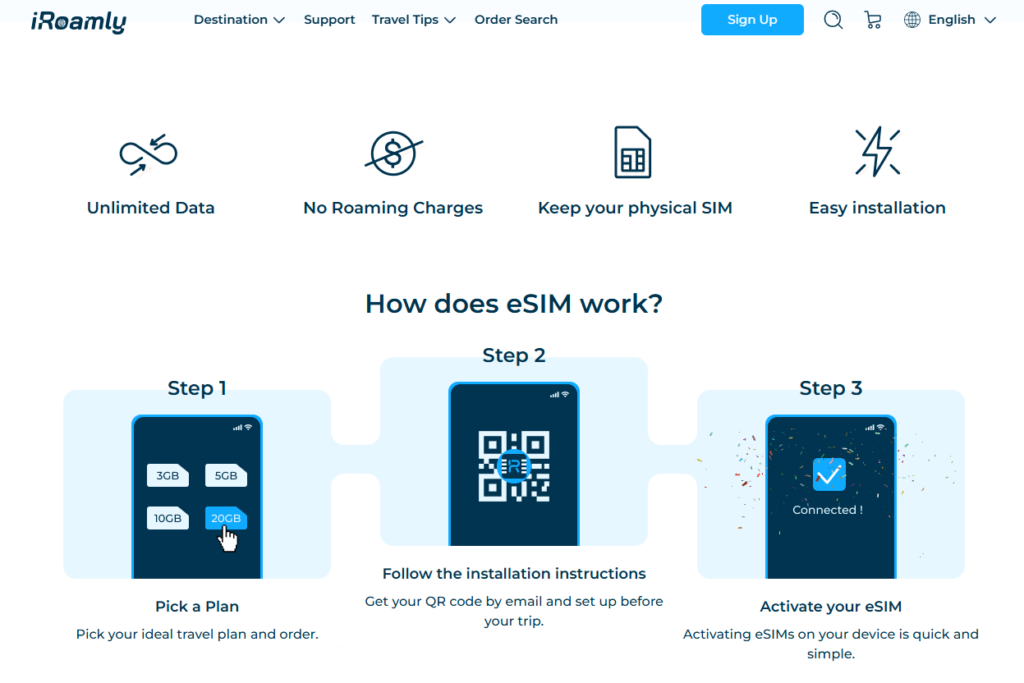
Step One: Select and Purchase
Choosing the Right Package
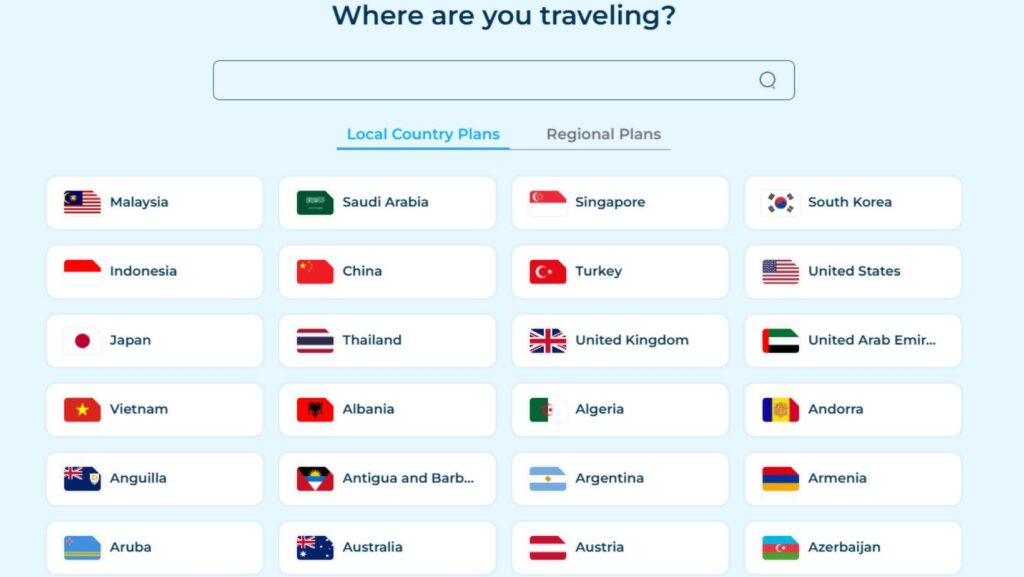
Visit the website or open the app, select your destination or region, and choose a plan based on your expected data usage and trip length. The page displays the validity period, data allowance, and price clearly. Payment is processed through secure gateways.
Step Two: Install the eSIM Profile
Receiving and Scanning the QR Code
After payment, you receive a QR code via email or on the success page. Use your device’s camera to scan the code or manually enter the activation details in your cellular settings. The profile downloads and installs in under two minutes. This step requires a stable internet connection, so it is best done at home or in a hotel with Wi-Fi.
A Note on Installation Timing
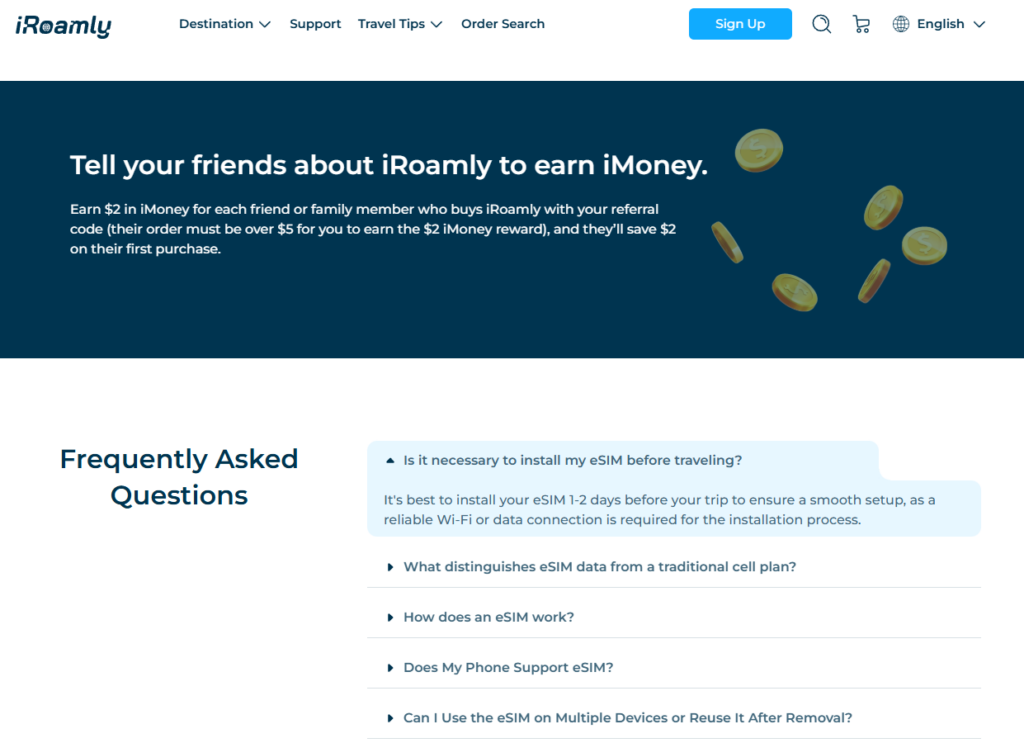
The recommendation is to install the eSIM one to two days before your departure. This allows time to troubleshoot any compatibility issues—though in my testing, none occurred. The profile is stored on your device but remains inactive until you turn it on.
Step Three: Activate Upon Arrival
Turning On the Service
Once you land at your destination, go to your device’s cellular settings, turn on the eSIM line, and enable data roaming for that line. The connection establishes automatically. There is no need to contact customer support or wait for an SMS.
A Quick Comparison of Common Options
To help clarify the trade-offs, the following table compares the service with the two most common alternatives.
|
Aspect |
iRoamly |
Home Carrier Roaming |
Local Prepaid SIM |
|
Cost Transparency |
Prepaid, fixed price |
Postpaid, variable |
Prepaid, but hidden fees possible |
|
Setup Complexity |
Low, done before travel |
None |
Medium, requires in-person visit |
|
Coverage Reach |
150+ countries via partners |
Home carrier’s global network |
Single country |
|
Validity Flexibility |
Daily, total, or unlimited plans |
Daily passes or per-MB |
Varies by provider |
|
Tethering Support |
Yes, on all paid plans |
Usually yes |
Often restricted |
|
Phone Number |
No (data only) |
Yes |
Yes |
This table reflects general trends and is based on publicly available information and my own experience. The best choice depends entirely on your travel style, destination, and willingness to trade convenience for cost.
What the Service Doesn’t Tell You
Every service has blind spots, and this one is no exception. The most important limitation is that the eSIM profile is tied to a single device. You cannot transfer it to another phone once installed. If you reset your device or remove the profile, you lose the remaining data. Additionally, the service is data-only. There is no voice or SMS capability, so if you need a local phone number for restaurant reservations or two-factor authentication, you will need a separate solution.
Customer support is available, but response times can vary—some users have reported delays during peak travel seasons. The free trial is a useful test, but it is limited to 500MB and one day, which is enough for basic testing but not for a full evaluation of coverage quality. Finally, the service does not own its infrastructure; it resells access from local carriers. This means that in countries where the partner network has poor coverage, your experience will be poor regardless of how much you paid.
Who This Approach Serves Best
Based on my testing, this service is most valuable for three types of travelers.
First, business travelers who value time above all else. The ability to land and connect instantly is worth the premium over hunting for a local deal. Second, vacationers who dislike surprises. Fixed pricing and clear data limits eliminate the stress of watching a roaming meter. Third, multi-country travelers who would otherwise need a new SIM for each border crossing.
It is less suited for those who need a local phone number, those traveling to extremely remote areas with no local partner coverage, or those on a strict budget who are willing to spend an hour finding the absolute cheapest local option. For the vast majority of casual to moderate travelers, the service represents a practical, cost-effective evolution of how we stay connected.
The shift away from physical SIMs is irreversible, and services like this one are making that shift accessible to everyone. It is not a magic bullet, but it removes enough friction to make international travel noticeably smoother. And that, for many travelers, is exactly what they need.