
A good presentation needs two things: clear structure and strong visuals.
Many AI presentation tools can create slides quickly, but the final deck often still feels rough. The text may be usable, but the visuals may look too generic. Some images do not match the slide topic. Some decks look inconsistent from slide to slide.
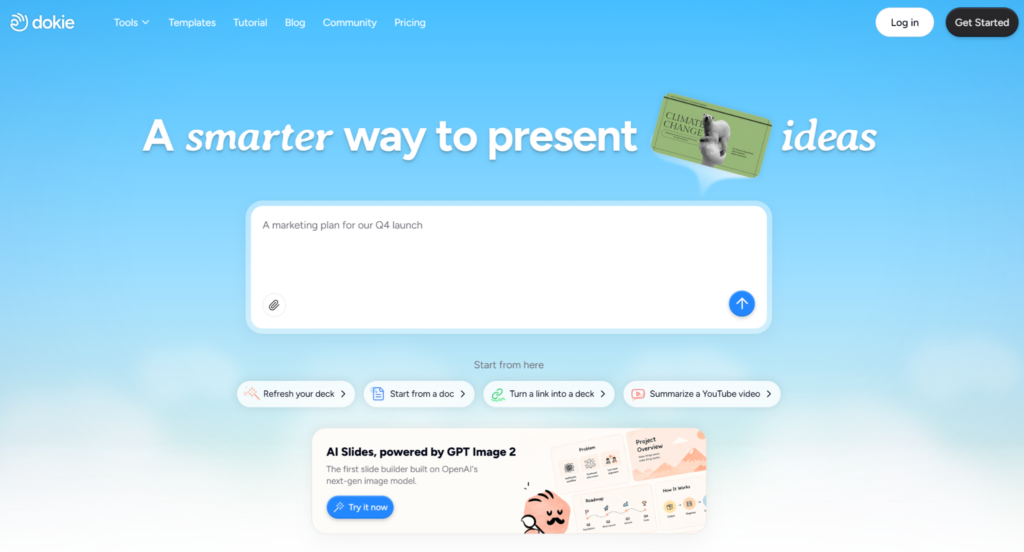
Dokie AI is trying to improve this experience. It helps users create PPT-style presentations with a clearer flow, editable slides, and now better image generation through GPT Image 2 support.
This Dokie AI review looks at how the tool works, why GPT Image 2 matters, and what types of users can benefit most from it.
What Is Dokie AI?
Dokie AI is an AI presentation maker that helps users create PowerPoint-style decks from prompts, notes, documents, or existing content.
Instead of opening a blank PPT and building every slide manually, users can describe the presentation they need. Dokie AI then helps generate a first draft with slide titles, content sections, visual direction, and a logical structure.
It can be used for many common presentation types, including business reports, startup pitch decks, marketing plans, education slides, product presentations, client proposals, training materials, technology decks, and personal portfolio slides.
The main value of Dokie AI is that it gives users a better starting point. You still need to edit and polish the deck, but you do not need to start from zero.
GPT Image 2 Is a Big Upgrade for Slide Quality
The most important highlight of Dokie AI is its support for GPT Image 2.
This upgrade improves one of the biggest weak points in AI-generated presentations: image quality.
In many AI slide tools, the visuals feel like placeholders. They may look acceptable at first glance, but they often do not support the slide message very well. This can make the final presentation feel less professional.
With GPT Image 2, Dokie AI can generate images that are more detailed, more natural, and more aligned with the actual slide content. This makes each slide feel more intentional.
For example, a slide about business growth can get visuals that better match strategy, data, or market expansion. A slide about AI productivity can use imagery that feels closer to automation and workflow. A slide about education can include visuals that support learning and explanation.
This makes the deck feel less generic and more presentation-ready.
Better Visuals Make the First Draft Stronger
The first draft is one of the most important parts of the presentation process.
If the first version looks too rough, users need to spend a lot of time replacing images, adjusting layouts, and fixing the overall design. That reduces the value of using an AI presentation maker.
Dokie AI’s GPT Image 2 support makes the first draft much stronger. The slides already feel more complete because the visuals are better matched to the topic.
This is useful for users who need to create slides quickly. You can generate a draft, review the structure, replace or edit key content, and spend less time fixing weak visuals.
For business users, this can save time when preparing weekly reports, client decks, marketing reviews, or internal updates.
More Professional Presentations for Work
Dokie AI is especially useful for work-related presentations.
Business decks need to look clean, but they also need to be easy to understand. A deck with random visuals can make the message feel weaker, even if the text is correct.
With GPT Image 2, Dokie AI can make slides look more polished from the beginning. This helps when creating:
Business reports
Marketing strategy decks
Product update presentations
Pitch decks
Sales decks
Client proposals
Training materials
Team updates
The improved visuals help the deck feel more professional, while the structure-focused workflow helps the content stay clear.
Stronger Structure Across the Whole Deck
Dokie AI is not only useful because of better image generation. It also helps build a clearer presentation structure.
This is important because a deck should not feel like a random group of slides. It should have a flow that guides the audience from the main idea to the final takeaway.
For a business report, the structure may include an overview, key metrics, insights, risks, and next steps.
For a pitch deck, it may include problem, solution, product, market, business model, traction, team, and ask.
For a marketing plan, it may include goals, audience, channels, content strategy, budget, timeline, and KPIs.
Dokie AI helps users create this structure faster. Then users can edit the content, add real data, and polish the final presentation.
Why GPT Image 2 Matters for Different Use Cases
For business reports, GPT Image 2 helps make slides look more polished and less like plain text summaries.
For marketing presentations, it can create visuals that better match campaign ideas, customer personas, growth channels, or brand strategy.
For pitch decks, it helps the deck feel more complete and professional before founders add real traction, product screenshots, and financial data.
For education slides, it can generate more helpful visuals that support explanation and learning.
For product presentations, it can help show technology, workflows, user scenarios, and feature ideas in a clearer way.
This makes Dokie AI useful across many presentation scenarios, not just one narrow use case.
PPT Templates for Different Needs
Dokie AI also offers PPT templates for different types of presentations.
Its template categories include Business, Education, Marketing, Medical, Technology, Pitch Deck, About Me, and Infographics.
This matters because different decks need different styles. A business review should look professional and clear. A pitch deck should feel persuasive and story-driven. An education deck should be simple and easy to follow. An infographic deck should help explain timelines, processes, data, or comparisons visually.
The template library helps users choose a better starting point before generating or editing the final deck.
Free PPT Tools for Existing Content
Another useful part of Dokie AI is its free PPT tools.
These include PDF to PPT, Word to PPT, Text to PPT, Excel to PPT, JPG to PPT, PNG to PPT, HTML to PPT, and DOC to PPT.
This is helpful because many presentations start from existing materials. You may already have a PDF report, a Word document, an Excel file, a text outline, a set of images, or an HTML page.
Dokie AI’s file-to-PPT tools help users turn those materials into presentation workflows faster. This makes the product more practical for real office use.
Pros of Dokie AI
Dokie AI helps users create structured presentation drafts quickly. This saves time and makes it easier to move from idea to slides.
Its support for GPT Image 2 is a major strength. The generated images look better, feel more relevant, and improve the overall quality of the deck.
Dokie AI also supports many practical use cases, including reports, pitch decks, marketing plans, education slides, product decks, and client presentations.
The PPT templates and free PPT tools make it useful for both new presentations and existing content conversion.
Cons of Dokie AI
Dokie AI is not a one-click final deck solution.
Users still need to review the content, check facts, add real numbers, adjust wording, and polish important slides. For high-stakes decks, such as investor presentations or major client proposals, manual editing is still important.
The quality of the output also depends on the input. A detailed prompt with audience, goal, slide count, and key points will usually create a better presentation than a very broad prompt.
Who Should Use Dokie AI?
Dokie AI is a good fit for office workers who create reports, updates, and meeting decks.
It is useful for marketers who need campaign reports, launch plans, SEO summaries, influencer marketing decks, and strategy presentations.
Founders can use it for pitch decks, investor updates, product decks, and business proposals.
Teachers and students can use it for lessons, class projects, research presentations, and training materials.
Consultants, agencies, and freelancers can use it for proposals, audits, client reports, and strategy decks.
Product and technology teams can use it for roadmap presentations, technical explainers, software updates, and SaaS decks.
Final Verdict
Dokie AI is a strong AI PPT maker for users who want faster presentation creation with better visual quality.
Its support for GPT Image 2 makes a clear difference. The generated images look more polished, more relevant, and more suitable for professional slides. This helps the final deck feel less like a basic AI draft and more like something users can edit and present.
At the same time, Dokie AI keeps a strong focus on presentation structure. That makes it useful for real work scenarios, not just quick design experiments.
If you often create business reports, pitch decks, marketing presentations, education slides, product decks, or client proposals, Dokie AI is worth trying.
FAQs
1. What is Dokie AI?
Dokie AI is an AI PPT maker that helps users create editable PowerPoint-style presentations from prompts, notes, documents, and existing content.
2. Does Dokie AI support GPT Image 2?
Yes. Dokie AI supports GPT Image 2, which helps improve the quality, relevance, and consistency of images generated for slides.
3. Why is GPT Image 2 useful for presentations?
GPT Image 2 helps create stronger visuals that match the slide topic better. This makes presentations look more polished and professional.
4. Is Dokie AI good for business decks?
Yes. Dokie AI is useful for business reports, strategy decks, product presentations, client proposals, marketing plans, and pitch decks.
5. Does Dokie AI provide PPT templates?
Yes. Dokie AI offers PPT templates for Business, Education, Marketing, Medical, Technology, Pitch Deck, About Me, and Infographics.
